数论
质数 Primes
质数的性质
数学符号“∣”的意义,如a∣b: ‘|’为整除符号,对于整数a,b(a≠0),若存在整数k,使b=ka,则称a整除b,或b能被a整除,记为a∣b。
d | n => n / d | n
也就是说 a * b = c, c能整除a, 也能整除b. 我们找质数只要遍历一遍较小的a即可
质数定理
在 1~n中有n / lnn个质数
试除法判定质数
1
2
3
4
5
6
7
8
9
10
11
12
13
14
15
16
17
18
19
20
21
22
23
24
25
26
27
28
29
30
| #include<iostream>
using namespace std;
const int N = 110;
bool is_Prime(int x)
{
if(x < 2) return false;
for(int i = 2; i <= x / i; i++)
if(!(x % i)) return false;
return true;
}
int main()
{
int n;
cin >> n;
while(n--)
{
int x;
cin >> x;
if(is_Prime(x)) cout<< "Yes";
else cout << "No";
cout << endl;
}
return 0;
}
|
试除法分解质因数
从小到大分别从n中除干净某个数
最后如果n不是1, 则说明最后一个质数大于根号n, 再单独输出n
1
2
3
4
5
6
7
8
9
10
11
12
13
14
15
16
17
18
19
20
21
22
23
24
25
26
27
28
29
30
31
32
33
34
35
36
37
38
39
40
41
42
| #include<iostream>
using namespace std;
int divied(int x)
{
for(int i = 2; i <= x / i; i++)
{
if(x % i == 0)
{
int t = 0;
while(x % i == 0)
{
x /= i;
t ++;
}
cout << i << ' ' << t << endl;
}
}
if(x != 1) cout << x << ' ' << 1 << endl;
return 0;
}
int main()
{
int n;
cin >> n;
while(n--)
{
int x;
cin >> x;
divied(x);
cout << endl;
}
return 0;
}
|
筛质数
我们把所有数的倍数全都删掉,剩下的数中间全部都不是 2 ~ p - 1的倍数
朴素代码 O(nlnn)
1
2
3
4
5
6
7
8
9
10
11
12
13
14
15
16
17
18
19
20
21
22
23
24
25
26
27
28
29
30
31
32
33
34
35
| #include<iostream>
using namespace std;
const int N = 10e6 + 10;
int st[N];
int get_primes(int n)
{
int ret = 0;
for(int i = 2; i <=n; i++)
if(!st[i]) for(int j = i + 1; j <= n; j++)
{
if(j % i == 0) {
if(!st[j])
{
st[j] = 1;
ret ++;
}
}
}
return n - ret - 1;
}
int main()
{
int n;
cin >> n;
cout << get_primes(n);
return 0;
}
|
优化方案, 我们不需要将每个数的倍数全部删掉,只需要把质数的倍数全部删掉. 减少重复计算量.
埃式筛法 O(n loglogn)
1
2
3
4
5
6
7
8
9
10
11
12
13
14
15
16
17
18
19
20
21
22
23
24
25
26
27
28
29
30
31
| #include<iostream>
using namespace std;
const int N = 10e6+10;
int prime[N];
int cnt;
char st[N];
int get_prime(int n)
{
for(int i = 2; i <= n; i++)
{
if(st[i] == 0)
{
prime[++cnt] = i;
for(int j = 2 * i; j <= n; j += i) st[j] = 1;
}
}
return cnt;
}
int main()
{
int n;
cin >> n;
cout << get_prime(n);
return 0;
}
|
线性筛法
n 只会被它的最小质因子删掉
1
2
3
4
5
6
7
8
9
10
11
12
13
14
15
16
17
18
19
20
21
22
23
24
25
26
27
28
29
30
31
32
33
34
35
36
37
38
| #include<iostream>
using namespace std;
const int N = 10e6 + 10;
int st[N];
int primes[N];
int cnt;
int get_primes(int n)
{
for(int i = 2; i <= n; i++)
{
if(!st[i]) primes[cnt++] = i;
for(int j = 0; primes[j] <= n / i ; j++)
{
st[primes[j] * i] = 1;
if(primes[j] % i == 0) break;
}
}
return cnt;
}
int main()
{
int n;
cin >> n;
cout << get_primes(n);
return 0;
}
|
当 $ n >= 10^{7}$ 时 线性筛法比埃式筛法快1倍
约数
int范围内的整数, 约数最多的个数为1500
试除法求约数 $O(\sqrt{n})$
遍历$ [1 , \sqrt{n}]$中所有的数,
如果能被$n$整除添加到答案中
特判$ n = i * i $的情况
1
2
3
4
5
6
7
8
9
10
11
12
13
14
15
16
17
18
19
20
21
22
23
24
25
26
27
28
29
30
31
32
33
34
35
36
37
38
39
| #include<iostream>
#include<vector>
#include<algorithm>
using namespace std;
const int N = 110;
vector<int> get_divisors(int n)
{
vector<int> ret;
for(int i = 1; i <= n / i; i++)
{
if(n % i == 0)
{
ret.push_back(i);
if(i != n / i) ret.push_back(n / i);
}
}
sort(ret.begin(),ret.end());
return ret;
}
int main()
{
int m;
cin >> m;
while(m--)
{
int n;
cin >> n;
vector<int> ret = get_divisors(n);
for(auto &p : ret) cout << p << ' ';
cout << endl;
}
return 0;
}
|
约数个数和约数之和
数学原理: 质因子分解
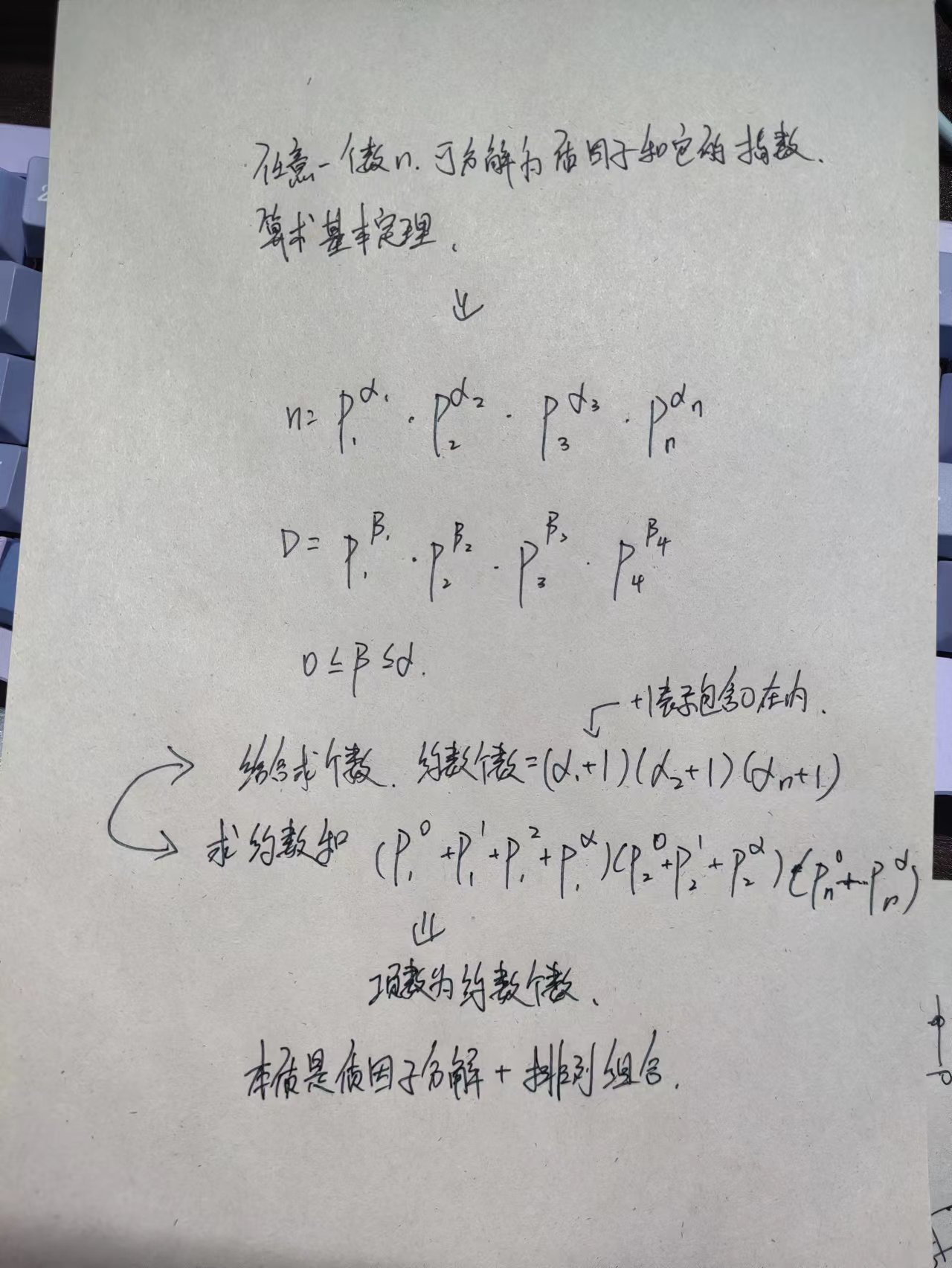
约数个数
1
2
3
4
5
6
7
8
9
10
11
12
13
14
15
16
17
18
19
20
21
22
23
24
25
26
27
28
29
30
31
32
33
34
35
36
37
38
| #include<iostream>
#include<unordered_map>
using namespace std;
const int mod = 1e9 + 7;
int main()
{
int n;
cin >> n;
unordered_map<int,int> prime;
while(n--)
{
int x;
cin >> x;
for(int i = 2; i <= x / i; i++)
{
while(x % i == 0)
{
x /= i;
prime[i]++;
}
}
if(x > 1) prime[x]++;
}
long long ret = 1;
for(auto &p:prime) ret = ret * (p.second + 1) % mod;
cout << ret;
return 0;
}
|
约数和
1
2
3
4
5
6
7
8
9
10
11
12
13
14
15
16
17
18
19
20
21
22
23
24
25
26
27
28
29
30
31
32
33
34
35
36
37
38
39
40
41
42
43
44
45
46
47
48
49
| #include<iostream>
#include<unordered_map>
using namespace std;
const int mod = 1e9 + 7;
int main()
{
int n;
cin >> n;
unordered_map<int,int> prime;
while(n--)
{
int x;
cin >> x;
for(int i = 2; i <= x / i; i++)
{
while(x % i == 0)
{
x /= i;
prime[i]++;
}
}
if(x > 1) prime[x]++;
}
long long ret = 1;
for(auto &p:prime)
{
int a = p.first, b = p.second;
long long t = 1;
while(b--)
{
t = (t * a + 1) % mod;
}
ret = ret * t % mod;
}
cout << ret;
return 0;
}
|
秦九昭算法 计算多项式之和
最大公约数 (欧几里得算法,辗转相除法)
算法原理
$d | a$ $d|b$ $d| ax + by$
$\gcd(a.b) = \gcd(b,a\mod b)$
1
2
3
4
5
6
7
8
9
10
11
12
13
14
15
16
17
18
19
20
21
22
23
| #include<iostream>
using namespace std;
int gcd(int a, int b)
{
return b ? gcd(b, a % b) : a;
}
int main()
{
int n;
cin >> n;
while(n--)
{
int x, y;
cin >> x >> y;
cout << gcd(x,y) << endl;
}
return 0;
}
|